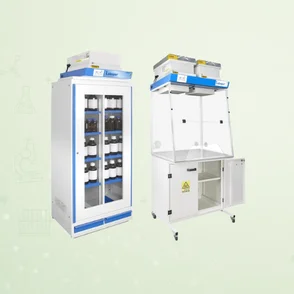
When you handle chemicals, your health can be put at risk by the release of noxious or even toxic vapours or powders. To protect yourself and your immediate environment, you should handle your products in an air recirculation fume hood (formerly known as a filtered air recirculation toxic enclosure or FACRE) fitted with either a molecular filter (or activated carbon filter), a particulate filter (or HEPA filter), or a molecular filter and a particulate filter.
Made in France, Labopur® fume hoods are manufactured and finished to the highest quality standards, in accordance with processes and procedures based on the ISO 9001 version 2008 quality standard.
What's more, our expertise has been successfully tested by independent French laboratories and inspection bodies in accordance with the May 2009 version of standard NF X 15.211.
The performance of labopur® ductless fume hoods has been assessed against standard NF X 15-211 - May 2009 by French laboratories and inspection bodies for :
Filtration tests.
Containment tests.
Tightness and integrity tests on the absolute filter (HEPA filter).
labopur® filtration fume hoods are manufactured according to Quality processes and procedures defined on the basis of the international standard ISO 9001 version 2008, at the end of the production line and before dispatch, in order to guarantee perfect operation and efficiency for the user.
- NF X 15-211 standard - May 2009:
- The NF X 15-211 standard is the most demanding regulation currently in force. It guarantees users enhanced safety, allowing them to concentrate on their work.
- Toxic enclosures with filtered air recycling are classified according to 2 safety levels:
- class 1: enclosure with safety reserve (2 activated carbon filters per filtration column)
- class 2: enclosure without safety reserve, the most commonly used enclosure (only 1 activated carbon filter per filtration column).
- Standard NF X 15-211 also distinguishes 3 classifications according to the type of filtration, depending on the chemical agents filtered:
- type P: for particle filtration (only available for class 2).
- type V: for vapour filtration (available for classes 1 and 2).
- type PV: for particle and vapour filtration
- (available for classes 1 and 2).