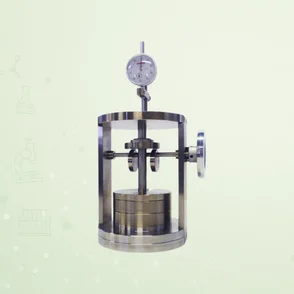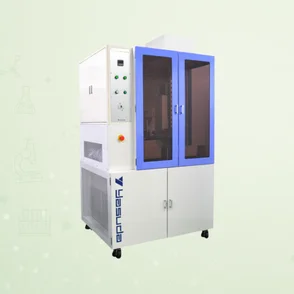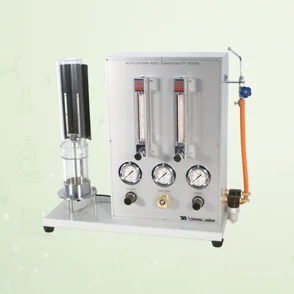
Placing the specimen on the parallel plate and after adding prescribed load for a specific amount of time, the plastometer reads the thickness of the specimen and multiplies the thickness 100 times to acquire the degree of plasticity.
Reference Standards
JIS K6249, ASTM D926, ISO 7323
- Short Description
- The Williams Parallel Plate Plastometer measures the plasticity of rubber and similar materials by measuring specimen thickness under a specified load for a set period.
- Features
- - Measures material plasticity accurately.
- - Parallel plate compression mechanism.
- - Built-in dial gauge for thickness measurement.
- - Applies a prescribed load for a specific duration.
- - Simple operation and easy readings.
- - Suitable for laboratory material testing.
- Model: No.105 WILLIAMS PARALLEL PLATE PLASTOMETER
- Specimen: Cylindrical shape, Volume 2 ± 0.02 cm3 (φ16 mm, H10 mm)
- Parallel Plate: Upper: φ148 mm, T11.7 mm
- Lower: φ148 mm, T13 mm
- Test Load: Initial 24.5 N (2.5 kgf) to Max. 49 ± 0.5 N (5 kgf) (Standard 49 ± 0.5 N)
- Dial Gauge: Scale 1/100 mm, Stroke Max. 20 mm
- Applications
- Suitable for evaluating the plasticity of raw rubber, unvulcanized rubber compounds, and similar materials. Ideal for rubber manufacturing industries, quality control laboratories, material testing facilities, and research departments.