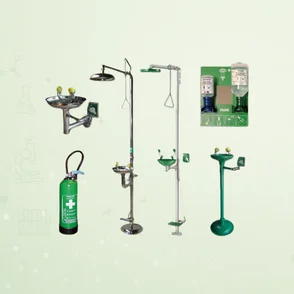
For people’s safety, the safety showers and eyewashers are essential in the premises where risks of chemicals projection exist. They are recommended in the chemical and pharmaceutical industries, automobile and food-processing industries, hospitals, water-treatment plants and swimming pools…
The first-aid equipments as showers and eye-washers have to be installed near the zones of danger. Their access must be easy and indicated clearly by normalized pictograms (supplied with our equipments).
Labour Code:
In accordance with Article R. 4224-14 of the Labour Code, workplaces must be equipped with first aid equipment that is appropriate to the nature of the risks and easily accessible.
ISO 3864:
This standard concerns the labelling of equipment. It is implemented at European level by Directive 92/58/EEC. All our first aid equipment is supplied with pictograms that comply with this standard.
- This standard applies to body showers connected to the water supply in laboratories. The main requirements of this standard are:
- The effective water distribution area, at a distance of 700 mm below the shower head, must comply with the following diagram: 95% of the water delivered must be within a circle with a diameter of 800 mm; 50% (± 10%) of the water must fall within a radius of 400 mm in diameter.
- The water flow must be constant and at least 60 L/min.
- The shower must be able to supply water for a minimum of 15 minutes.
- The water velocity must be low enough so as not to injure the user.
- The height under the shower head must be 2200 ± 100 mm from the floor.
- The water supply tap must not close automatically.
- The manufacturer must supply the equipment with installation, operating and maintenance instructions.
- The shower must be supplied with standardised signage (see opposite).
- For personal safety, safety showers and eye wash stations are essential in areas where there is a risk of hazardous substances being splashed. They are therefore recommended in:
- the chemical and pharmaceutical industries,
- the food and automotive industries,
- chemical, petrochemical and biochemistry laboratories,
- municipal workshops, garages and printing works,
- universities, secondary schools and colleges,
- hospitals and clinics,
- water treatment plants and swimming pools, etc.
- First aid equipment, showers and eye wash stations must be installed close to danger zones. They must be easily accessible and clearly marked.